Significant progress has been achieved in the development of the SKADI small-angle neutron scattering (SANS) instrument, following successful testing of its detector system.
The results demonstrate not only that the system can detect neutrons, but also that it can operate within the ESS standardised data acquisition system.
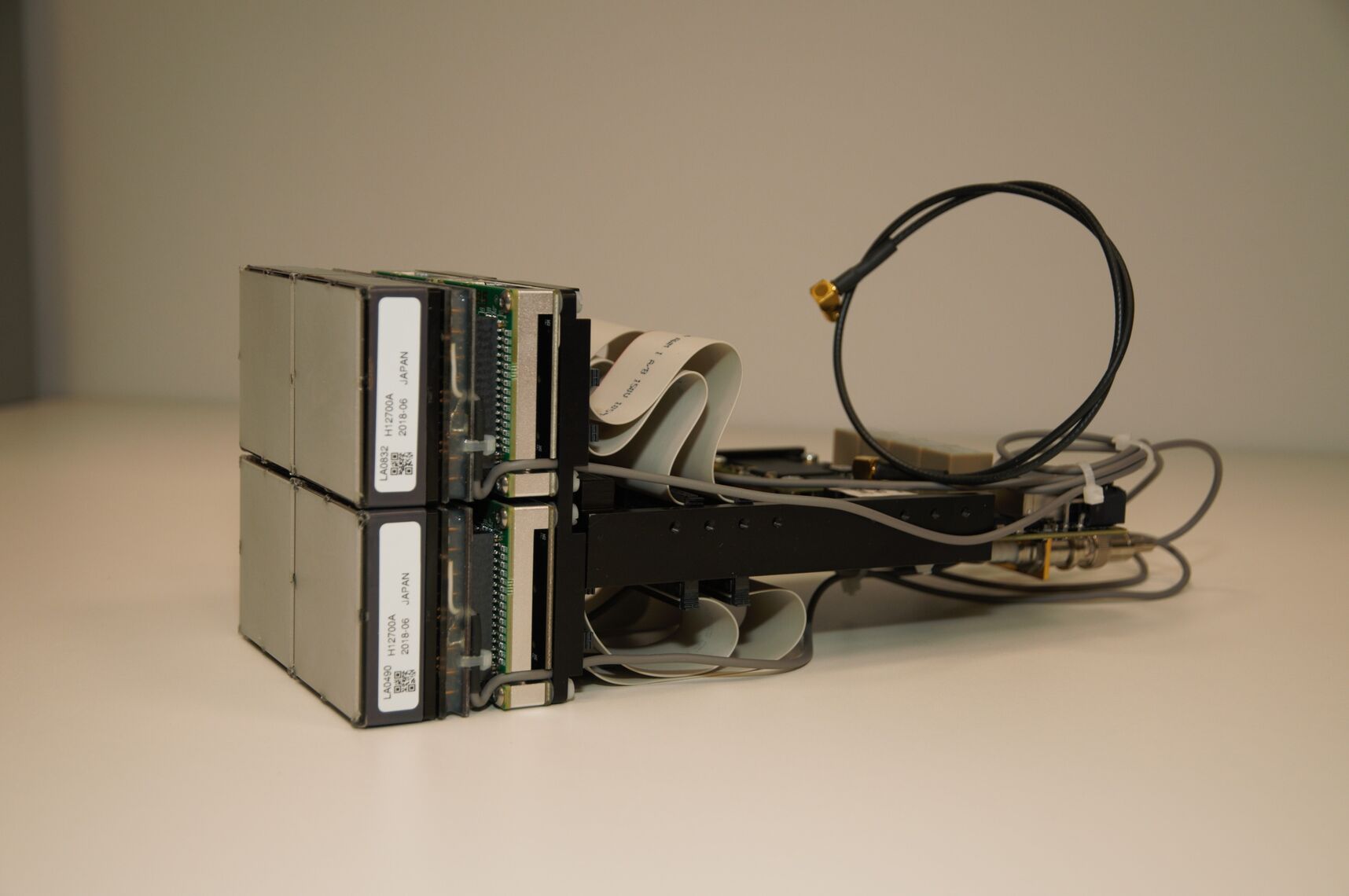
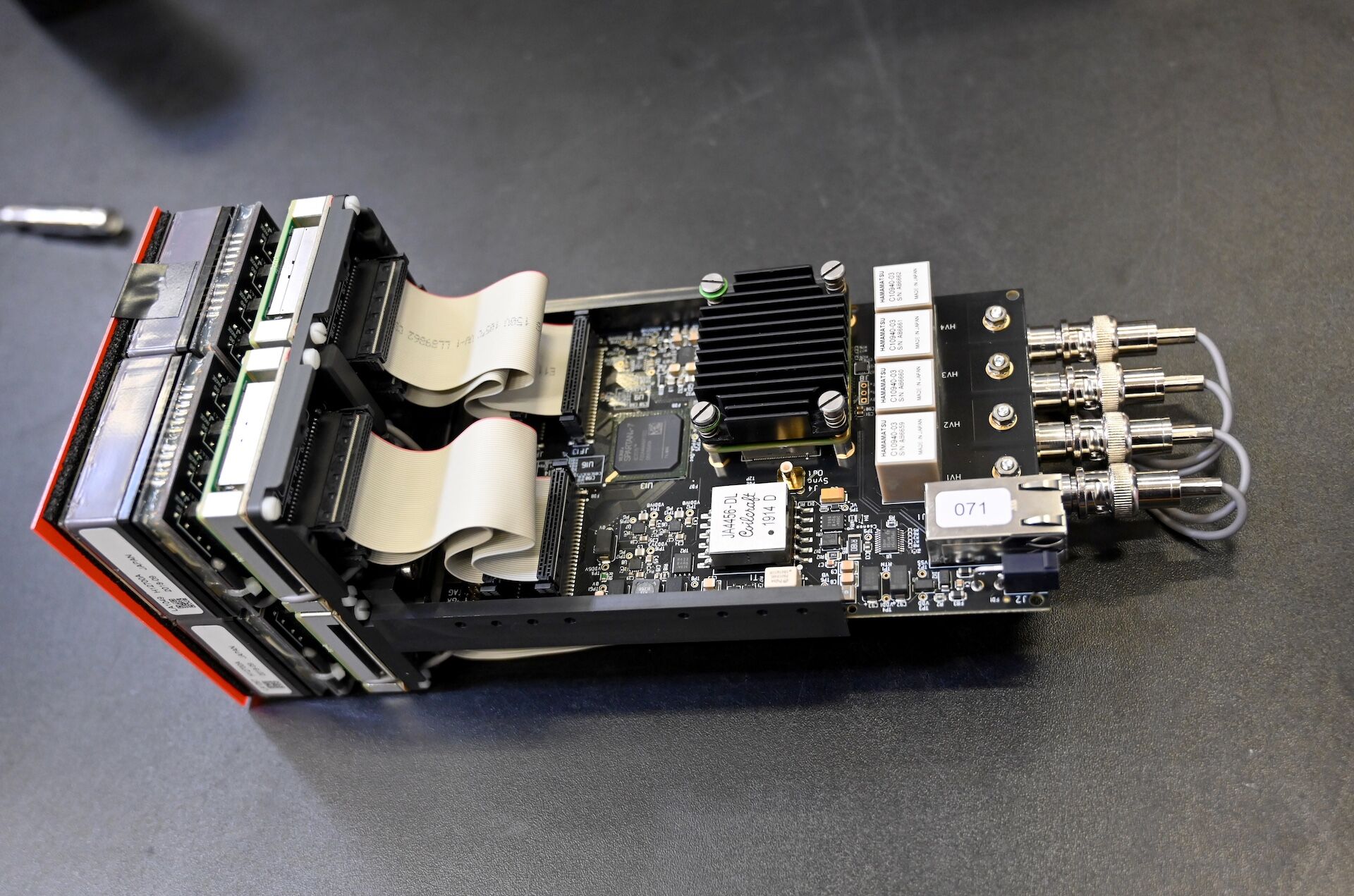
The initial SKADI detector setup consists of 96 detector tiles arranged in modular assemblies and fully integrated with electronics, control interfaces, and data connections. Each tile functions both as an individual detector and as a modular part of the larger system.
The setup includes extensive cabling for signal transmission and synchronisation with the ESS timing system, as well as a data link to the Data Management and Scientific Computing (DMSC) centre in Denmark.
A key objective of the test was to validate the robustness and integrity of the detection of neutrons, as well as the transport of and storage of data. This includes the time stamping of each individual neutron with the very high rates necessary for a measurement with neutrons, where up to 100 million neutrons may arrive per second.
Validated readiness for neutron detection
The most important outcome of the test was the demonstration that the detector system is fully capable of detecting neutrons using the ESS data pipeline. The results confirm that the full detection chain is functioning as designed.
Detecting neutrons is inherently challenging, as they cannot be seen, smelled, or heard. In SKADI they are converted into detectable flashes of blue light by a process called scintillation. This happens after the neutron has passed through the sample that is being investigated. For the test, the detected events were visualised as pixelated patterns, providing clear graphical evidence that the system is registering neutron interactions as expected. The detector is not only operational, but already sensitive enough to capture real neutron signals under operational conditions.
International collaboration and local expertise
The detector components were delivered as an in-kind contribution from Forschungszentrum Jülich in Germany and developed by a consortium from four countries, Sweden, Germany, France and Norway.
At the Utgård workshop in Lund, the ESS Detector Group assembled the full test setup and performed end-to-end integration of the detector system into the ESS instrument readout and control framework, in close collaboration with the SKADI team.
Looking ahead to installation and operation
Installation of the SKADI detector system is scheduled to begin in June 2026. It is expected to be amongst the first instruments to receive neutrons when ESS begins operations, and be ready for early science experiments in 2027.
About SKADI
SKADI is optimised for very small scattering angles, enabling high-resolution studies of systems such as protein clusters, polymer aggregates, and other materials with long characteristic length scales. With its polarisation capabilities it will also be able to investigate magnetic phenomena, and superconducting materials.
The instrument is being developed in collaboration with in-kind partners Forschungszentrum Jülich (Germany) and LLB (France).
Find out more about the SKADI instrument