
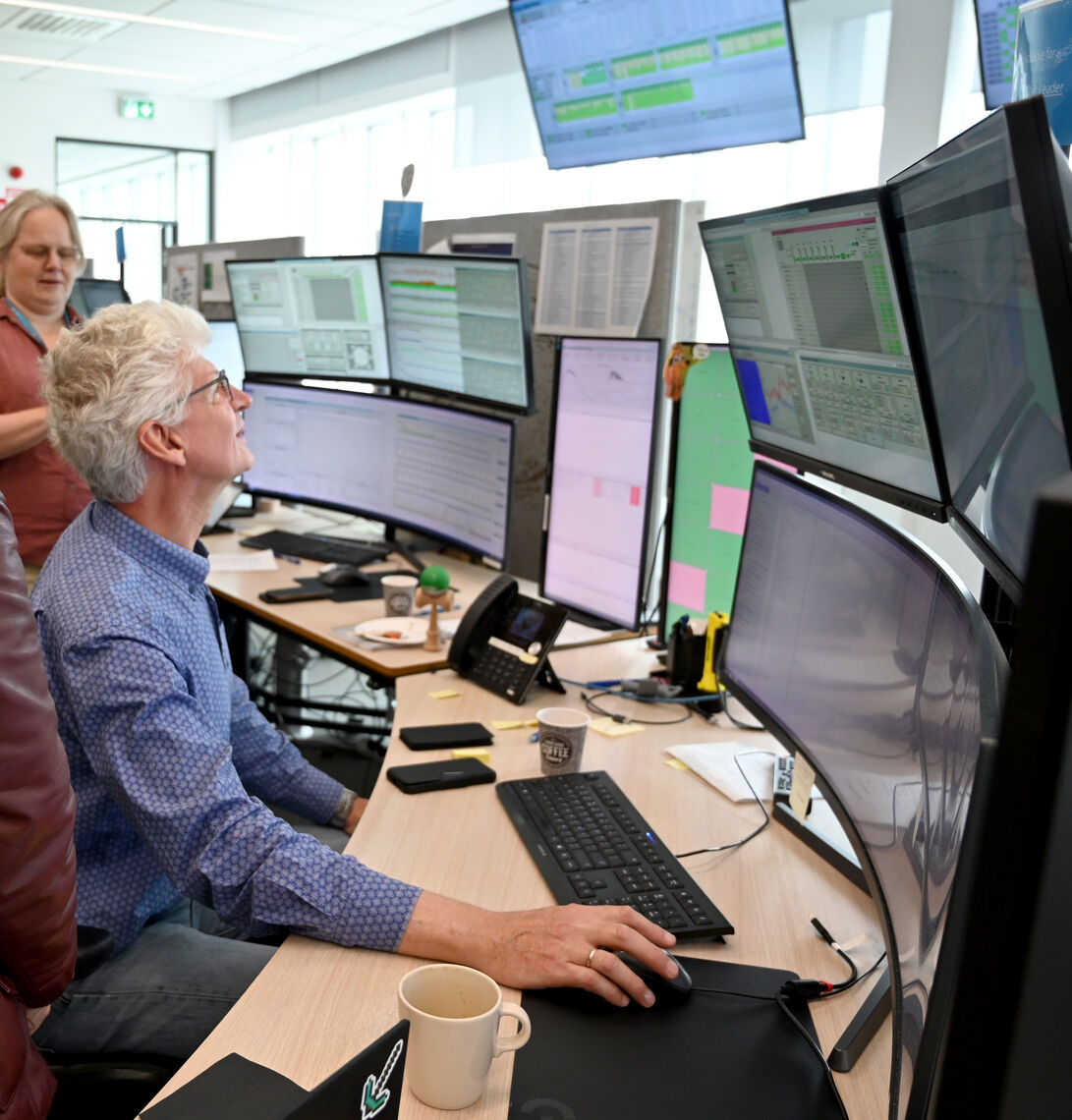
Accelerating protons all the way to the beam dump in 2025 was a major achievement for ESS. Now the facility has successfully completed the second commissioning to dump phase (BoD2), edging closer to full commissioning of its accelerator and the ultimate goal – to deliver beam to the target and produce the first neutrons.
Just over a year ago, ESS celebrated a milestone in the facility’s road to producing neutrons and becoming a world-leading centre for neutron science. In May 2025, protons were accelerated to the required energy all the way from the ion source to the tuning beam dump – 542.5 metres down the accelerator tunnel.
Achieving Beam on Dump (BoD) marked the start of full commissioning of the accelerator: a step-by-step process to ensure that cryomodules, radio-frequency (RF) cavities, power converters, beam diagnostics, cooling systems, control systems, and other components are ready to operate as one machine. Control room staff, engineers, physicists and technicians are working tirelessly to prepare the ESS accelerator for first neutrons, planned for early 2027.
The second commissioning phase – Beam on Dump 2 (BoD2) – is now complete. The ESS accelerator has been shut down for the summer; a new commissioning phase will start in the autumn.
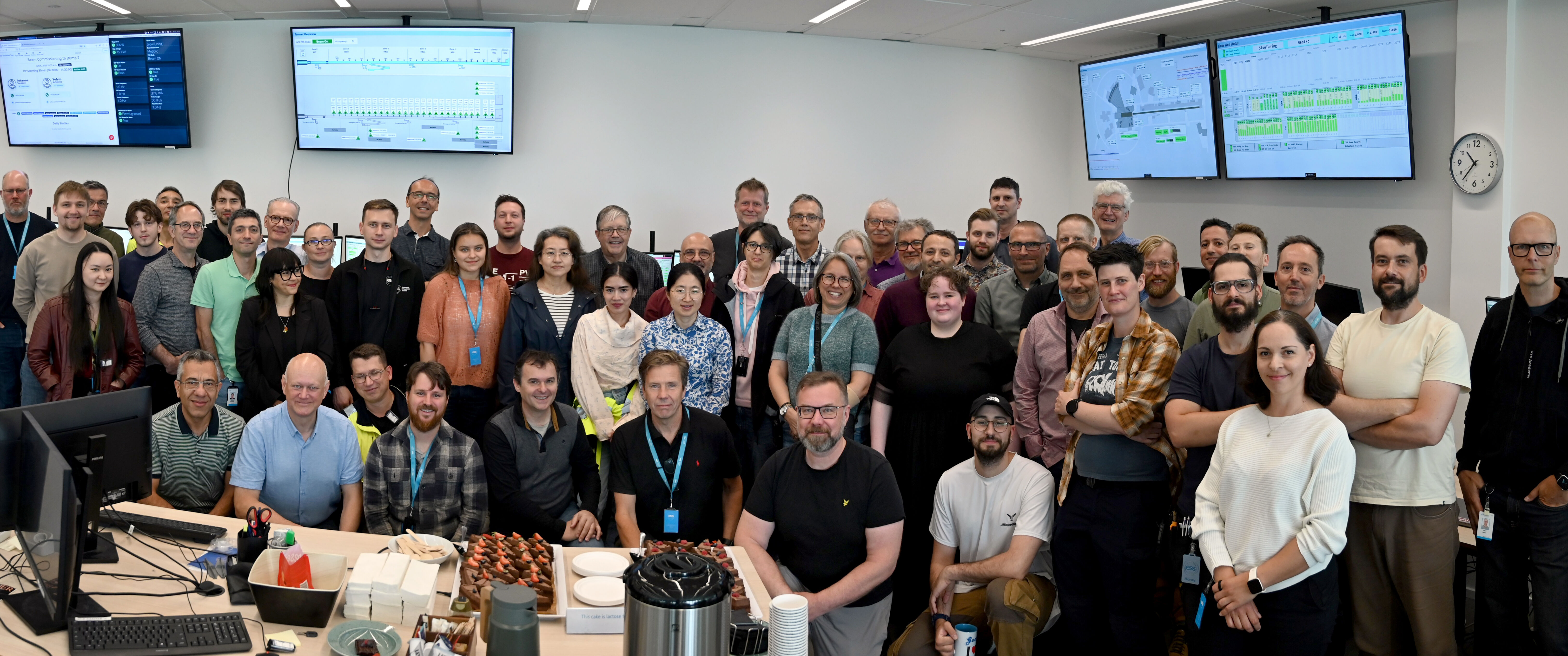
Beam on Dump 2
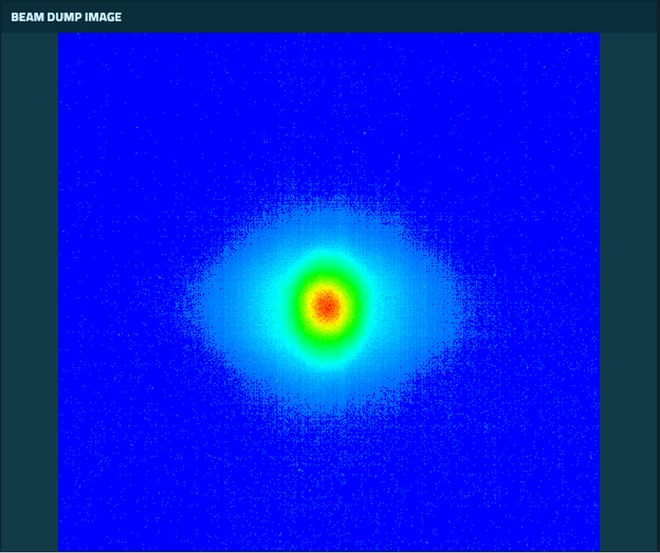
BoD2 started in February 2026. Over the past four months, teams across ESS have again transported the proton beam through the different sections of the accelerator: first through the normal conducting linac and, in March, through the superconducting linac. Since early May, the beam has been stably “floating” to the tuning beam dump, with an energy of 800-860 MeV (million electron-volts). The beam has effectively reached the dump again, where it is safely absorbed.
However, unlike in 2025, the goal is no longer to simply reach the dump. The accelerator must now be able to operate at increasingly higher beam power while maintaining stable and reliable performance.

When fully operational, the ESS accelerator will deliver a pulsed proton beam with 2 MW average beam power to the rotating tungsten target wheel. When the high-energy protons strike the heavy metal target, neutrons will be released in a process called spallation. The neutrons will then be guided to various experimental stations, where researchers will study materials at the atomic and molecular level.
To reach 2 MW beam power, several parametres must be adjusted: the energy of the beam, the intensity of the current, the length of the pulse of protons and their repetition rate.
ESS teams have been gradually bringing each parameter to the level required for the accelerator to function at 2 MW. Sequentially and separately, and without unacceptable beam losses along the length of the accelerator, they have increased the length of the proton pulses to 1.5 ms (compared to 0.005 ms in May 2025), the repetition rate of the pulses to 14 Hz (up from 1 Hz in May 2025) and the beam current to 62.5 mA.
Each step entails constant adjustments to the accelerator components. Daniel Noll, a physicist in the Beam Physics group describes a few: “The 89 RF cavities need to be perfectly aligned to get to the desired energy (of 800 MeV). A higher beam current implies more particles in the beam, which increases the repulsion between them; to counteract this repulsion, magnets need to be adjusted and more power needs to be injected into the beam. And when we increase the pulse length and repetition rate, the heat load on the RF cavities increases too, and this also needs to be managed”.
A beautiful beam
Distributed along the accelerator are more than 500 instruments that measure and characterise the beam as it travels down the linac. They monitor key parameters including beam current, beam position in the tube and beam losses. Together, these instruments provide a diagnosis of the state of the beam and ensure that the accelerator is protected from damage.
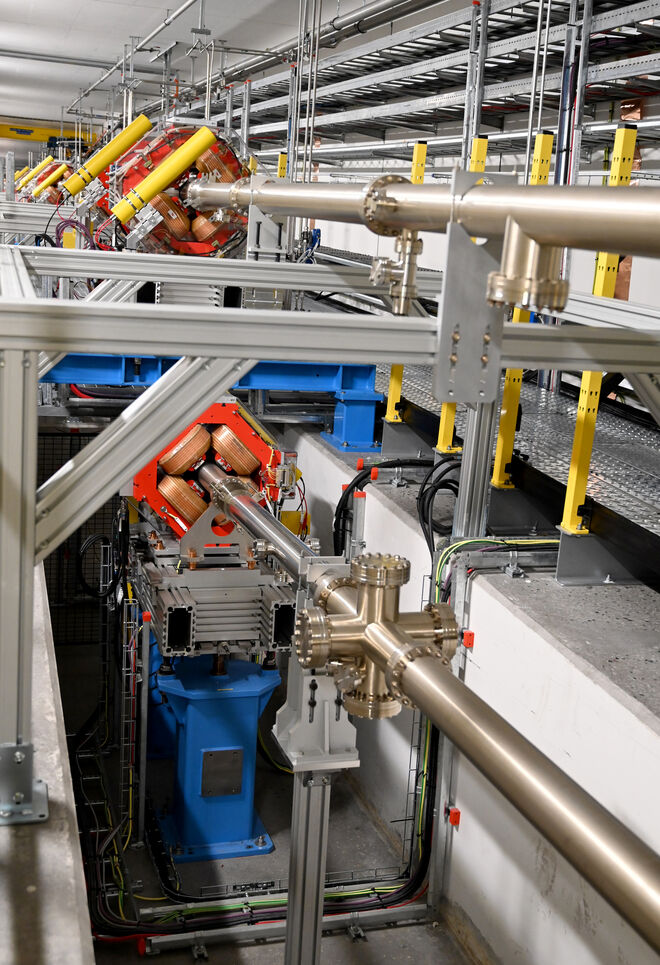
Irena Dolenc Kittelmann and Hooman Hassanzadegan, both in the Beam Diagnostics group, describe what makes a good beam: it sits in the centre of the beam tube, within an allowed space “envelope”; its protons are not lost along the way (lost protons lead to a drop in the current of the beam and also to radiation of components); last but not least, the beam pulses have clean and sharp beginnings and endings. The instruments that Irena Hooman and colleagues designed and installed quietly safeguard the beam’s efficiency, stability, and quality.